

Debt Recovery in the UAE 2026: How to Recover Money from a Debtor and Enforce Court Judgments
Language links are proposed publishing URLs. Update both addresses after publishing and configure hreflang through your multilingual SEO plugin.

Unpaid personal loans, overdue invoices, bounced cheques and unsatisfied court judgments can create significant financial pressure for individuals and businesses. Debt recovery in the UAE requires more than sending repeated demands. A creditor must identify the right debtor, establish the financial obligation, select an appropriate legal route and consider whether there are assets from which the amount can actually be collected.
This guide explains how to recover money from a debtor in the UAE, including documentary evidence, settlement, payment orders, civil and commercial claims, asset attachment and court judgment enforcement. It covers issues that may arise in Dubai, Abu Dhabi and other Emirates without assuming that every case follows the same court procedure. The content is general information, not a prediction of a particular outcome.
What Does Debt Recovery in the UAE Mean?
Debt recovery in the UAE is the process of seeking payment of a financial obligation through voluntary settlement or lawful court procedures. A creditor may hold a contract, an acknowledgment, a cheque or a judgment, but each document serves a different purpose. The first task is to identify the underlying obligation and the correct debtor. The second is to decide whether a demand, payment order, ordinary claim or enforcement application fits the available evidence. Obtaining a judgment and collecting the money are separate stages. A legally valid claim does not by itself establish that assets are available for collection.
Practical preparation matters. Create a dated chronology that identifies each payment, request, response and supporting record. Mark what is admitted and what remains disputed. This gives counsel a useful starting point for assessing the case, choosing the appropriate procedure and explaining the likely costs.
Which Types of Debts Can Be Claimed?
Recoverable claims may arise from personal loans, unpaid invoices, delivered goods, completed services, construction works, contractual refunds and cheques. The legal remedy depends on the facts. A request to recover an advance payment for services never delivered may differ from a claim for an overdue loan instalment. A creditor should separate the principal amount from disputed charges and distinguish contractual payment claims from damages claims. This prevents inaccurate calculations and helps the court understand exactly what performance or payment is requested.
When considering the next step, distinguish legal entitlement from commercial collectability. A claim may be well supported yet difficult to collect if the debtor has no accessible assets. Conversely, a documented settlement with reliable security may achieve a better outcome without an extended trial.
How to Prove a Debt Before UAE Courts

A clear documentary trail is central to recovering money from a debtor in the UAE. Relevant evidence can include signed contracts, bank statements, transfer receipts, invoices, delivery acknowledgments, payment schedules, returned-cheque documents and written admissions. Evidence should be organized chronologically and matched to the amounts claimed. An unexplained bank transfer may show that money moved, without conclusively proving that the recipient was obliged to repay it. The reason for the payment therefore matters as much as the transfer itself.
Every case should also be assessed for procedural risks. Court jurisdiction, required translations, proper service, corporate identity and the effect of previous settlements can change the available options. These matters should be checked against current law and the documents rather than assumed from a general article.
Legal Demands and Amicable Collection
A properly drafted demand can identify the creditor, debtor, amount, legal basis and requested payment date. It may create an opportunity for settlement before litigation, although formal notice requirements vary according to the remedy and contract. Communications should be professional and supported by records, not threats or unsupported allegations. If the debtor proposes instalments, the agreement should identify the acknowledged balance, dates, default consequences and any security. A promise to pay is not equivalent to receipt of funds.
Preserve the evidence in its original form and maintain a clear accounting of the balance. Do not omit payments that have already been received. Where facts remain uncertain, identify them openly so that the proposed claim does not overstate what the documents can actually prove.
Recovering Money Without a Written Contract
The absence of a signed agreement does not necessarily prevent a debt claim. Depending on the applicable evidence rules, correspondence, acknowledgments and banking documents may help establish the transaction. WhatsApp messages or emails may be relevant where their authenticity and context can be demonstrated. Keep complete conversations rather than isolated screenshots and preserve original digital files where possible. However, electronic messages should not be described as automatically conclusive: their weight depends on their content, attribution and the circumstances of the dispute.
Practical preparation matters. Create a dated chronology that identifies each payment, request, response and supporting record. Mark what is admitted and what remains disputed. This gives counsel a useful starting point for assessing the case, choosing the appropriate procedure and explaining the likely costs.
Recovering a Personal Loan
A personal loan dispute commonly turns on whether the transfer was intended as a repayable loan rather than a gift, reimbursement or payment for something else. An acknowledgment stating the amount and repayment date can be particularly helpful. Where the arrangement was informal, contemporaneous messages may show that the recipient requested a loan and agreed to repay it. Calculate all partial repayments before sending a demand. Debt recovery lawyers should also review any applicable limitation issues and the borrower’s correct identity before commencing proceedings.
When considering the next step, distinguish legal entitlement from commercial collectability. A claim may be well supported yet difficult to collect if the debtor has no accessible assets. Conversely, a documented settlement with reliable security may achieve a better outcome without an extended trial.
Commercial Debt Collection Between Companies
Business-to-business claims often involve purchase orders, invoices, delivery notes, acceptance certificates and correspondence about defective goods or incomplete work. The creditor must identify the contracting legal entity, not merely the trading name or the individual who negotiated the transaction. A limited liability company and its manager are not automatically interchangeable defendants. Arbitration clauses, jurisdiction agreements and payment certification provisions may change the available route. Commercial debt collection in the UAE is stronger when the accounts reconcile with the contractual documents.
Every case should also be assessed for procedural risks. Court jurisdiction, required translations, proper service, corporate identity and the effect of previous settlements can change the available options. These matters should be checked against current law and the documents rather than assumed from a general article.
Recovering the Value of a Bounced Cheque
A returned cheque can be an important document in a financial claim. The appropriate procedure depends on the circumstances of dishonour and the current rules governing cheques and execution. It would be inaccurate to assume that every bounced cheque automatically creates a criminal case or travel ban. Preserve the original cheque, bank return memo and communications about the underlying transaction. Any part-payment or later settlement should be disclosed and correctly reflected in the outstanding balance before an enforcement or court application is made.
Preserve the evidence in its original form and maintain a clear accounting of the balance. Do not omit payments that have already been received. Where facts remain uncertain, identify them openly so that the proposed claim does not overstate what the documents can actually prove.
Payment Orders and Ordinary Debt Claims
Certain documented and due monetary obligations may qualify for a payment-order procedure, subject to the applicable legal conditions. Other disputes require an ordinary civil or commercial claim, particularly when there are substantial factual disagreements. The creditor should assess the form of the obligation, the documentation, any required notice and the court’s procedural rules. Choosing the wrong track can create delay and unnecessary expense. A payment order is a legal procedure with defined conditions, not a universal shortcut for all unpaid debts.
Practical preparation matters. Create a dated chronology that identifies each payment, request, response and supporting record. Mark what is admitted and what remains disputed. This gives counsel a useful starting point for assessing the case, choosing the appropriate procedure and explaining the likely costs.
Debt recovery in the UAE, How to recover money from a debtor in UAE, Debt collection lawyer in Dubai, Financial claim in UAE courts, Court judgment enforcement in UAE
Choosing the Competent Court
Jurisdiction depends on factors such as the defendant’s location, the nature of the claim, the contractual arrangements and the relevant judicial system. Dubai and Abu Dhabi have local courts, while other matters may fall within the federal judiciary. Some financial free-zone disputes may be subject to distinct jurisdictional rules. Arbitration provisions may also be relevant. Before filing a debt recovery claim in the UAE, review the contract, company documents and places connected with the transaction rather than assuming that one court is always appropriate.
When considering the next step, distinguish legal entitlement from commercial collectability. A claim may be well supported yet difficult to collect if the debtor has no accessible assets. Conversely, a documented settlement with reliable security may achieve a better outcome without an extended trial.
Precautionary Attachment of Assets
Precautionary attachment is designed to preserve property in circumstances allowed by law. It is not an automatic remedy available simply because a creditor says a debt is unpaid. The application must be supported by the relevant facts and documents, and the court may impose procedural requirements or safeguards. Attachment does not mean that the creditor has already received the money. It may preserve an asset pending determination of rights and any subsequent enforcement steps. The necessity and proportionality of such a request should be assessed carefully.
Every case should also be assessed for procedural risks. Court jurisdiction, required translations, proper service, corporate identity and the effect of previous settlements can change the available options. These matters should be checked against current law and the documents rather than assumed from a general article.
Enforcing a Court Judgment in the UAE
After obtaining a judgment or another enforceable instrument, a creditor may need to open an execution file with the competent authority. The procedural requirements vary by judicial body and by the instrument being enforced. Applications can involve documentary checks, fees, service and judicial orders. The UAE Ministry of Justice publishes an official service for registering execution files within its system. Court judgment enforcement in the UAE is a distinct process from winning the underlying case, and progress may depend on locating assets that can lawfully be seized.
Preserve the evidence in its original form and maintain a clear accounting of the balance. Do not omit payments that have already been received. Where facts remain uncertain, identify them openly so that the proposed claim does not overstate what the documents can actually prove.
Official reference: Ministry of Justice — Registration of an Execution File. Check the competent authority for your particular case.
Debt recovery in the UAE, How to recover money from a debtor in UAE, Debt collection lawyer in Dubai, Financial claim in UAE courts, Court judgment enforcement in UAE
Attachment of Bank Accounts and Property
Depending on the law and judicial orders, enforcement measures may concern funds held by banks, vehicles, real estate or amounts owed to the debtor by third parties. The presence of a bank account does not guarantee that it contains an attachable balance. Property may be subject to mortgages, third-party rights or other legal restrictions. Creditors must use authorized court processes rather than attempting to obtain private banking information unlawfully. Asset recovery decisions should consider cost, priority claims and the realistic proceeds of any sale.
Practical preparation matters. Create a dated chronology that identifies each payment, request, response and supporting record. Mark what is admitted and what remains disputed. This gives counsel a useful starting point for assessing the case, choosing the appropriate procedure and explaining the likely costs.
Official reference: Ministry of Justice — Request for Attachment of Funds and Property.
Travel Bans for Unpaid Debts
An unpaid civil debt does not automatically result in a travel ban. UAE civil procedure provides conditions and judicial safeguards governing applications to restrict a debtor’s travel. The availability of such relief depends on the specific facts and legal requirements, not on a creditor’s demand alone. A travel-ban application should not be confused with attachment of property or an order to pay. It is particularly important to distinguish lawful judicial remedies from threats made during informal collection efforts.
When considering the next step, distinguish legal entitlement from commercial collectability. A claim may be well supported yet difficult to collect if the debtor has no accessible assets. Conversely, a documented settlement with reliable security may achieve a better outcome without an extended trial.
Recovering Debt from a Closed Company
An expired trade licence or the closure of business premises does not by itself resolve who owes the money. The company’s legal form, liquidation status, available assets and contractual guarantees must be examined. A manager or shareholder does not become personally liable for every company debt merely by holding that position. Personal guarantees, independently actionable conduct or other specific legal grounds may alter the analysis. Obtain accurate corporate documents and identify the actual contractual debtor before selecting defendants or proposing enforcement steps.
Every case should also be assessed for procedural risks. Court jurisdiction, required translations, proper service, corporate identity and the effect of previous settlements can change the available options. These matters should be checked against current law and the documents rather than assumed from a general article.
Debt recovery in the UAE, How to recover money from a debtor in UAE, Debt collection lawyer in Dubai, Financial claim in UAE courts, Court judgment enforcement in UAE
When a Debtor Transfers Assets to Others
A transfer of assets during a dispute can raise questions about the enforceability of transactions against creditors, sham dealings or other remedies where legal conditions are met. But a sale or transfer is not automatically fraudulent. A responsible review considers the transaction date, consideration, parties, debtor’s obligations and available evidence. Records must be obtained lawfully. The appropriate response may require a separate claim or a protective application, and it should be assessed on evidence rather than suspicion alone.
Preserve the evidence in its original form and maintain a clear accounting of the balance. Do not omit payments that have already been received. Where facts remain uncertain, identify them openly so that the proposed claim does not overstate what the documents can actually prove.
Debt Recovery When the Debtor Leaves the UAE
Departure from the country does not necessarily extinguish the debt. The creditor should first investigate whether attachable assets or enforceable rights remain within the UAE. International recovery may depend on the foreign country, applicable treaties, recognition requirements and the location of assets. A UAE judgment is not automatically enforceable everywhere. Cross-border debt recovery requires separate assessment of service, translations, authentication and foreign execution rules. The commercial value of enforcement should be weighed against the cost of proceedings abroad.
Practical preparation matters. Create a dated chronology that identifies each payment, request, response and supporting record. Mark what is admitted and what remains disputed. This gives counsel a useful starting point for assessing the case, choosing the appropriate procedure and explaining the likely costs.
Instalment Plans and Settlements During Enforcement
Parties may negotiate a payment schedule even after litigation has begun or an execution file has been opened. The settlement should specify the acknowledged balance, instalment dates, bank details, default events, security and the effect on pending proceedings. Creditors should distinguish suspension of enforcement from final satisfaction of the debt. A full release should not be issued inadvertently before the agreed payments are received. A carefully structured settlement can sometimes produce better practical recovery than prolonged contested proceedings.
When considering the next step, distinguish legal entitlement from commercial collectability. A claim may be well supported yet difficult to collect if the debtor has no accessible assets. Conversely, a documented settlement with reliable security may achieve a better outcome without an extended trial.
Debt recovery in the UAE, How to recover money from a debtor in UAE, Debt collection lawyer in Dubai, Financial claim in UAE courts, Court judgment enforcement in UAE
How Long Does Debt Recovery Take?
There is no reliable fixed duration for every debt recovery case in the UAE. A well-documented, uncontested obligation may proceed differently from a commercial dispute requiring accounting expertise or multiple hearings. Service, procedural challenges, appeals and the availability of assets affect the timetable. The time needed to obtain a judgment should be distinguished from the time needed to collect under it. Any estimate should identify the assumptions behind it and avoid promising a guaranteed completion date.
Every case should also be assessed for procedural risks. Court jurisdiction, required translations, proper service, corporate identity and the effect of previous settlements can change the available options. These matters should be checked against current law and the documents rather than assumed from a general article.
Costs of Filing and Enforcing a Debt Claim
Potential expenses include court filing fees, service charges, translation, expert fees, execution charges and legal representation. The amounts depend on the court, claim value and procedural route. A cost-benefit assessment should examine not only the amount owed but also the evidence, likely defenses and identifiable assets. Some cases justify staged legal work: document review, demand and negotiation, litigation, then enforcement. The economically sensible approach may differ for a modest personal loan and a substantial corporate receivable.
Preserve the evidence in its original form and maintain a clear accounting of the balance. Do not omit payments that have already been received. Where facts remain uncertain, identify them openly so that the proposed claim does not overstate what the documents can actually prove.
Common Mistakes That Delay Recovery
Frequent mistakes include suing the wrong entity, claiming an inaccurate amount, failing to deduct partial payments, losing original documents and confusing a money claim with execution of a judgment. Informal promises without documented terms can lead to repeated delays. Public accusations, harassment or unlawful pressure may create separate legal exposure and should be avoided. A better approach is to preserve records, identify the correct legal remedy and consider enforcement prospects before investing heavily in litigation.
Practical preparation matters. Create a dated chronology that identifies each payment, request, response and supporting record. Mark what is admitted and what remains disputed. This gives counsel a useful starting point for assessing the case, choosing the appropriate procedure and explaining the likely costs.
Debt recovery in the UAE, How to recover money from a debtor in UAE, Debt collection lawyer in Dubai, Financial claim in UAE courts, Court judgment enforcement in UAE
Frequently Asked Questions About Debt Recovery
Can a creditor recover money without a receipt? Possibly, where other legally acceptable evidence supports the claim. Can a bank account be frozen immediately? Only through the relevant lawful procedure and judicial authority. Does a favorable judgment guarantee payment? No; enforcement and available assets still matter. Does a returned cheque automatically cause a travel ban? No. Can money be recovered from a debtor overseas? Sometimes, subject to assets and cross-border legal rules. Each answer depends on the facts and should be reviewed with the supporting documents.
When considering the next step, distinguish legal entitlement from commercial collectability. A claim may be well supported yet difficult to collect if the debtor has no accessible assets. Conversely, a documented settlement with reliable security may achieve a better outcome without an extended trial.
When to Consult a Debt Recovery Lawyer
Professional review becomes particularly important when the claim is substantial, evidence is disputed, assets appear to be moving, several companies are involved or a judgment remains unpaid. A lawyer can assess the debtor’s identity, contractual obligations, forum, possible protective relief and enforcement options. The objective is not always to file immediately. In some cases, an evidence-based demand or secured settlement offers a better prospect of recovering money from a debtor in the UAE than litigation without a realistic asset strategy.
Every case should also be assessed for procedural risks. Court jurisdiction, required translations, proper service, corporate identity and the effect of previous settlements can change the available options. These matters should be checked against current law and the documents rather than assumed from a general article.
Debt recovery in the UAE, How to recover money from a debtor in UAE, Debt collection lawyer in Dubai, Financial claim in UAE courts, Court judgment enforcement in UAE
Official Sources and Further Reading
Official UAE legislation and court services should be checked for current procedural requirements. The UAE Legislation Portal provides access to legislation; the Ministry of Justice publishes federal execution services; and Dubai Courts and the Abu Dhabi Judicial Department provide information for their respective jurisdictions. For related guidance and firm information, readers may consult the legal resources published on both office websites. Internal links should point only to pages confirmed to exist, rather than invented article addresses.
Preserve the evidence in its original form and maintain a clear accounting of the balance. Do not omit payments that have already been received. Where facts remain uncertain, identify them openly so that the proposed claim does not overstate what the documents can actually prove.
Official references: UAE Legislation Portal, Ministry of Justice, Dubai Courts, and Abu Dhabi Judicial Department.
Firm resources: advo-uae.com and advocatorae.com. Article-level links should be added only after the relevant live pages have been checked.
Contact the Law Firm
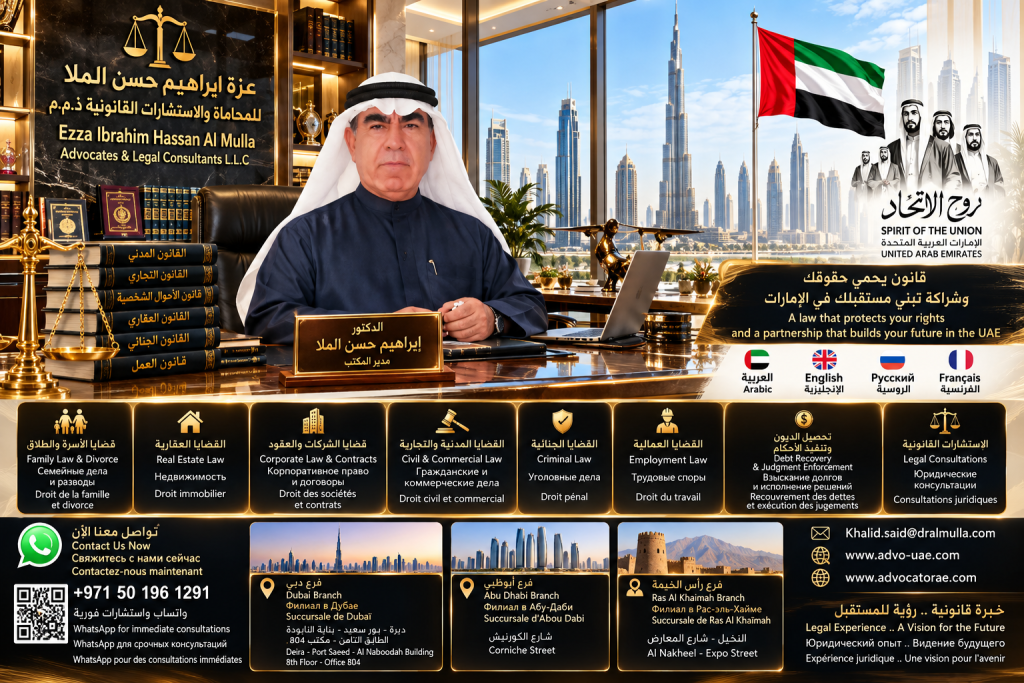
Azza Ibrahim Hassan Al Mulla Advocates & Legal Consultants L.L.C. is available to review documents concerning unpaid loans, commercial debts, cheques, judgments and execution matters. Consultant Dr. Ibrahim Hassan Al-Mulla is the director of the office. The Dubai office is located in Port Saeed, Deira, Al Naboodah Building, eighth floor, Office 804, near City Centre Deira. Branches are also listed in Abu Dhabi and Ras Al Khaimah. To arrange a consultation, prepare the contract, banking evidence, correspondence, statements of account and any existing court or execution documents.
Practical preparation matters. Create a dated chronology that identifies each payment, request, response and supporting record. Mark what is admitted and what remains disputed. This gives counsel a useful starting point for assessing the case, choosing the appropriate procedure and explaining the likely costs.
Phone: +971 50 196 1291.
WhatsApp: 00971501961291.
Email: info@advocatorae.com.
Websites: advo-uae.com and advocatorae.com.
Legal disclaimer: This article provides general preliminary legal information and does not constitute detailed legal advice. The applicable law, jurisdiction and court procedures must be checked against the individual facts and current official requirements.
Debt recovery in the UAE, How to recover money from a debtor in UAE, Debt collection lawyer in Dubai, Financial claim in UAE courts, Court judgment enforcement in UAE