

Intellectual Property Protection for Companies in the UAE 2026: Trademarks, Patents, Copyright and Trade Secrets

Intellectual property protection for companies in the UAE is a fundamental consideration for businesses operating in one of the region’s most competitive and innovation-driven economies.
A company may invest years in building its reputation, developing products, creating software and attracting customers. Yet an improperly drafted agreement, an unregistered trademark or an unauthorized disclosure of confidential information can expose that investment to substantial risk.
These concerns affect businesses of every size. Startups, family-owned enterprises, manufacturers, professional service firms, technology developers and online retailers all depend on intellectual assets.
Effective intellectual property protection for companies in the UAE extends beyond obtaining registration certificates. It involves identifying valuable assets, confirming ownership, managing contracts, monitoring commercial use and responding appropriately to infringement.
Businesses operating in Dubai, Abu Dhabi, Sharjah, Ras Al Khaimah and the other emirates should understand the federal laws governing trademarks, inventions, industrial designs, copyright and related rights.
They should also distinguish between ownership of intellectual property and permission to use assets belonging to another party.
This 2026 guide explains the principal legal protections available in the United Arab Emirates, common commercial risks, practical registration considerations and steps businesses can take to strengthen their position.
It also examines the importance of intellectual property during financing, corporate restructuring, mergers and acquisitions, and disputes involving employees, developers or commercial partners.
1. What Does Intellectual Property Mean for Companies in the UAE?
Intellectual property refers to legally recognized rights associated with inventions, creative works, commercial identifiers and other protected intellectual assets.
For businesses, these rights can represent an important source of economic value. They may support product differentiation, customer recognition, technology licensing and long-term competitive advantage.
Intellectual property protection for companies in the UAE begins with understanding which business assets qualify for protection and which legal rules govern them.
Identifying intellectual assets
A company’s assets may include its business logo, product names, software applications, technical inventions, industrial designs, advertising materials and confidential operational information.
Not every asset receives the same form of legal protection. A trademark differs from a patent, while copyright and trade-secret protection serve distinct purposes.
Ownership versus permission to use
Businesses frequently obtain technology, designs or content from external contractors. Payment for a service does not necessarily establish ownership of every related intellectual property right.
The legal position depends on the applicable law, the nature of the work and the contractual terms governing ownership or licensing.
Why documentation matters
Registration certificates, assignment agreements, development contracts and evidence of authorized use can be important when proving rights.
Without adequate documentation, a business may encounter difficulties during an infringement dispute or investor due diligence.
Therefore, intellectual property protection for companies in the UAE should be treated as an ongoing business function rather than a one-time registration exercise.
2. UAE Intellectual Property Laws Applicable in 2026
Intellectual property protection for companies in the UAE is governed by several federal laws, supported by implementing regulations and relevant administrative procedures.
Businesses should identify the applicable legal framework before filing applications, entering licensing arrangements or commencing proceedings.
Trademark legislation
Federal Decree-Law No. 36 of 2021 concerning Trademarks regulates matters including registration, protection, ownership transactions and infringement.
The implementing regulations address important procedural requirements. Companies should verify the current forms, fees and deadlines before submitting applications.
Copyright legislation
Federal Decree-Law No. 38 of 2021 concerning Copyright and Neighbouring Rights governs the protection of qualifying original works and related rights.
Depending on the circumstances, protected works may include software, written content, artistic creations and other original material.
Industrial property legislation
Federal Law No. 11 of 2021 concerning the Regulation and Protection of Industrial Property Rights addresses patents, utility certificates, industrial designs and other rights within its scope.
Each category has its own requirements. An invention should not be assumed to qualify for a patent merely because it is commercially useful.
Government and judicial authorities
The UAE Ministry of Economy and Tourism provides services associated with trademarks and other intellectual property matters.
Depending on the alleged infringement, customs authorities, competent government bodies and courts may also have relevant responsibilities.
Companies can consult the official UAE legislation portal for published federal legislation.
Legal analysis must consider the applicable legislation, any subsequent amendments, implementing rules and the specific facts of the case.
Sound intellectual property protection for companies in the UAE depends on applying the correct law to the correct asset.
3. Why Intellectual Property Protection Matters to UAE Businesses

Ezza Ibrahim Hassan Al Mulla Dr: Ibrahim Hassan Al Mulla
مكتب عزه ابراهيم الملا للمحاماة من اعرق اقدم مكاتب المحاماة في الامارات بادارة الدكتور إبراهيم حسن الملا المنصوري
Companies compete through their reputation, products, customer experience and ability to innovate.
Intellectual property rights can support these commercial advantages by establishing legally recognized interests in valuable business assets.
Protecting brand reputation
A misleadingly similar mark may confuse customers about the origin of products or services.
If inferior goods are associated with an established brand, customer confidence may suffer even when the genuine business did not supply those goods.
Supporting investment
Investors often examine whether a company owns the trademarks, software and technology on which its operations depend.
Unclear ownership or unresolved disputes may affect negotiations, transaction conditions or risk assessments.
Encouraging innovation
Businesses may invest substantial resources in research, design and product development.
Appropriate legal protection can help organize commercial exploitation of the resulting assets, subject to the requirements of the relevant law.
Reducing contractual uncertainty
Clear agreements with employees, developers and suppliers help establish the intended allocation of rights.
They may also reduce disagreements concerning future modifications, sublicensing and use after termination.
Intellectual property protection for companies in the UAE is particularly relevant to technology firms, manufacturers, retailers, professional practices and digital businesses.
Nevertheless, registration does not eliminate every commercial risk. Effective protection also requires contractual management, recordkeeping and periodic review.
4. Main Types of Intellectual Property Rights
The appropriate legal strategy depends on the asset being protected. Different intellectual property rights cover different subject matter and require different evidence.
| Type of right | Typical asset | Key consideration |
|---|---|---|
| Trademarks | Brand names, logos and distinctive signs | Search, classification, registration and renewal |
| Patents | Qualifying technical inventions | Novelty, inventive step and industrial applicability |
| Industrial designs | Qualifying product appearance | Eligibility and applicable registration requirements |
| Copyright | Original software, content and creative works | Authorship, ownership and licensing |
| Trade secrets | Confidential commercial or technical information | Secrecy and appropriate protective measures |
Multiple rights in one product
A single product may involve several distinct rights. Its brand may be protected as a trademark, its original software through copyright, and its technical invention through patent law where eligible.
Its external appearance may also qualify for industrial design protection, depending on the applicable requirements.
Prioritizing valuable assets
A retail company may depend primarily on its brand, while a software developer may depend on proprietary code and licensing arrangements.
A manufacturing business may require protection for inventions, designs and confidential production processes.
Consequently, intellectual property protection for companies in the UAE should be based on an asset-specific assessment rather than a standardized registration package.
5. Trademark Registration in the UAE
Trademark registration is an important part of intellectual property protection for companies in the UAE.
A properly selected and registered mark can provide a stronger legal basis for protecting a brand within the scope established by law.
Conducting a preliminary search
Before filing, a business should investigate whether earlier marks may conflict with its proposed name or logo.
Similarity can involve pronunciation, appearance, meaning or the relationship between the relevant products and services.
Selecting appropriate classes
Trademark applications identify the goods and services for which protection is sought.
The selection should reflect actual business operations and realistic expansion plans. Registration in one class should not be assumed to protect every possible activity.
Filing and examination
Applications are submitted through the relevant official channels with the required information and documents.
The process may involve examination, publication and opportunities for objection under the applicable rules.
Responding to objections
An earlier rights holder may challenge an application where legally recognized grounds exist.
The applicant should examine the objection and supporting evidence before deciding whether to respond, negotiate or modify its approach.
Registration duration and renewal
Under the UAE trademark framework, the registration protection period is ten years, with renewal available subject to the prescribed requirements.
Businesses should monitor renewal deadlines and current administrative procedures.
Trade names are not identical to trademarks
A trade name registered for business licensing purposes does not automatically provide the same legal protection as a registered trademark.
The two systems have different purposes and requirements.
Businesses can review official services through the Ministry of Economy and Tourism services portal.
Early trademark planning can strengthen intellectual property protection for companies in the UAE before significant expenditure on branding and advertising.
6. Patent Protection and Industrial Innovation
Ezza Ibrahim Hassan Al Mulla Dr: Ibrahim Hassan Al Mulla
مكتب عزه ابراهيم الملا للمحاماة من اعرق اقدم مكاتب المحاماة في الامارات بادارة الدكتور إبراهيم حسن الملا المنصوري
Technical inventions can form the foundation of a company’s competitive position.
Manufacturers, engineering businesses and technology developers should assess patent eligibility before disclosing potentially valuable inventions.
Patent eligibility
The relevant legislation establishes requirements that include novelty, inventive step and industrial applicability.
Not every new business concept or product improvement necessarily meets these conditions.
Technical and legal assessment
Patent preparation may require a review of existing technology, technical documentation and the intended scope of the claims.
Accurate descriptions can be important because the claims define the protection sought.
Confidentiality before filing
Premature public disclosure may create legal difficulties concerning novelty, depending on the facts and applicable rules.
Businesses should consider appropriate confidentiality arrangements before sharing technical information with potential investors or suppliers.
Joint development projects
Inventions may result from cooperation between companies, universities, laboratories or independent engineers.
Agreements should address ownership, filing responsibilities, licensing and commercial exploitation.
Protection in multiple countries
Patent rights are territorial in nature. Filing in the UAE does not automatically establish equivalent rights in every other jurisdiction.
International filing routes may be available, but the ultimate scope of protection depends on the relevant legal systems.
Additional official background is available through the UAE Government intellectual property information portal.
Effective intellectual property protection for companies in the UAE requires coordination between technical specialists, management and legal advisers.
7. Copyright Protection for Software and Digital Content
Software, websites, applications and creative materials are central to many modern businesses.
Copyright may protect qualifying original works under the applicable UAE legislation.
Software ownership
A company may use a software product without owning the underlying intellectual property rights.
It is important to distinguish a software license from an assignment of ownership.
Websites and applications
A website may contain several protected elements, including original text, photographs, graphics and software.
Each component may have a different author, owner or licensing arrangement.
Marketing materials
Agencies often create advertising campaigns, videos, illustrations and brand assets for corporate clients.
The relevant agreement should clarify permitted use, modifications, duration and any transfer of rights.
Source code and future development
Software development contracts should address source-code delivery, maintenance, updates and rights to engage replacement developers.
Failure to regulate these matters can create significant operational dependence on the original supplier.
Open-source software
Open-source components can be commercially valuable, but their licenses may impose conditions concerning notices, distribution or modifications.
Companies should maintain records of important third-party software dependencies.
Unauthorized copying
If protected content is copied without permission, the business should preserve evidence and examine the ownership position and applicable legal exceptions.
The appropriate response depends on the nature and extent of the alleged use.
Intellectual property protection for companies in the UAE should therefore include careful contract review and systematic management of digital assets.
8. Protecting Trade Secrets and Confidential Business Information
Some of a company’s most valuable information may never be publicly disclosed.
Confidential production methods, pricing models, customer information and technical processes can support a commercial advantage.
Identifying confidential information
Businesses should identify which information genuinely requires restricted access.
Merely labeling a document confidential does not necessarily establish that it meets every legal requirement for protection.
Non-disclosure agreements
Appropriate confidentiality agreements can regulate information shared with employees, contractors, suppliers and potential investors.
The terms should be sufficiently clear and consistent with applicable law.
Access controls
Employees should generally have access to information necessary for their responsibilities.
Permissions should be reviewed when employees change positions or leave the business.
Documenting protective measures
Training records, information classifications, access policies and contractual safeguards can help demonstrate that a business took confidentiality seriously.
The measures should reflect the sensitivity of the information and the risks involved.
Responding to a leak
Where confidential information may have been disclosed improperly, the company should preserve evidence and establish the relevant facts.
Legal options should then be assessed in light of contractual obligations, applicable legislation and any demonstrable harm.
For trade secrets, intellectual property protection for companies in the UAE relies heavily on consistent internal conduct, not simply written policies.
9. Employees, Developers and Intellectual Property Ownership
Ezza Ibrahim Hassan Al Mulla Dr: Ibrahim Hassan Al Mulla
مكتب عزه ابراهيم الملا للمحاماة من اعرق اقدم مكاتب المحاماة في الامارات بادارة الدكتور إبراهيم حسن الملا المنصوري
Some intellectual property disputes arise within a business rather than between competitors.
Disagreements may concern software developed by an employee, a logo created by an agency or an invention produced during a joint project.
Employment contracts
Companies should review the legal treatment of works and inventions created during employment.
Contractual clauses must be considered alongside the mandatory provisions of applicable law.
Independent contractors
Payment for a commissioned work should not be assumed to transfer every intellectual property right automatically.
Appropriate assignments or licenses may be necessary depending on the type of work and the governing legal rules.
Software development agreements
Contracts should distinguish pre-existing software from components developed specifically for the client.
They should also regulate source code, modifications, third-party libraries and continuing support.
Jointly created assets
Where several contributors develop a product, the business should identify each contribution and clarify ownership arrangements.
Unresolved questions can become especially problematic when the product is commercialized or sold.
Termination procedures
Employee and contractor exit procedures should address confidential information, access permissions and return of relevant materials.
Any continuing restrictions should be assessed for legal enforceability.
Proper contractual planning is an essential component of intellectual property protection for companies in the UAE.
10. Licensing, Distribution and Franchise Agreements
Businesses often permit commercial partners to use trademarks, technology or other intellectual assets.
These arrangements should define the permitted activities and the rights retained by the owner.
Geographical scope
A license should identify the territories in which the recipient may operate.
Unclear territorial provisions may lead to conflicts between distributors or undermine an expansion strategy.
Products and services
The agreement should specify the products or services for which the intellectual property may be used.
It should not unintentionally authorize unrelated commercial activities.
Exclusivity
Businesses should determine whether a license is exclusive or non-exclusive and whether sublicensing is permitted.
These provisions can materially affect future business opportunities.
Quality standards
Appropriate quality-control arrangements can help preserve brand reputation.
The scope of monitoring should reflect the nature of the products and the commercial relationship.
Expiry and termination
The contract should regulate the cessation of authorized use after termination.
This may include signage, websites, packaging, advertising materials and digital accounts.
Further background on related commercial disputes is available in the firm’s commercial litigation and companies resource.
Clear licensing arrangements strengthen intellectual property protection for companies in the UAE while supporting controlled commercial expansion.
11. Intellectual Property Protection in UAE E-Commerce
Online stores, marketplaces and social media have become major channels for commercial activity.
They also create opportunities for unauthorized use of brands, photographs and other protected materials.
Imitation online stores
A third party may create a website using a similar name, logo or product presentation.
The business should assess whether the conduct infringes protected rights and whether consumers may be misled.
Domain names
Companies should maintain control over important domain registrations and monitor potentially confusing registrations where commercially justified.
Owning a domain name does not automatically establish trademark ownership.
Photographs and advertising
Images available online are not necessarily free for commercial reuse.
Businesses should maintain records of licenses and permissions for advertising materials.
Social media accounts
Agreements with marketing agencies should identify account administration responsibilities, content rights and access arrangements.
Account handover obligations are particularly important when the agency relationship ends.
Artificial intelligence content
Companies using generative AI tools should review applicable platform terms and the legal implications of commercial use.
They should not assume that every generated output has the same copyright status as an original human-authored work.
Digital operations require intellectual property protection for companies in the UAE to be coordinated with marketing, cybersecurity and contract management.
12. Legal Steps When a Trademark Is Infringed

Ezza Ibrahim Hassan Al Mulla Dr: Ibrahim Hassan Al Mulla
مكتب عزه ابراهيم الملا للمحاماة من اعرق اقدم مكاتب المحاماة في الامارات بادارة الدكتور إبراهيم حسن الملا المنصوري
A business may discover products, advertisements or online pages using a mark that appears to imitate its brand.
Before acting, the business should identify the rights involved and preserve relevant evidence.
Preserving evidence
Useful records may include product photographs, invoices, advertisements, supplier details and dated communications.
Digital evidence should be preserved in a manner suitable for the circumstances of the dispute.
Checking the legal position
Trademark certificates, relevant classes, ownership documents and the nature of the alleged use should be examined.
Not every resemblance between two products or marks necessarily establishes infringement.
Considering a legal notice
A carefully prepared notice may be appropriate in some disputes.
However, certain situations may require a different approach to preserve evidence or prevent continuing harm.
Administrative and judicial options
Depending on the facts and applicable law, the business may consider complaints to competent authorities or proceedings before the courts.
The appropriate forum and remedies must be identified before filing.
Commercial settlement
Negotiation may resolve some disputes, particularly where the parties have an existing business relationship.
Any settlement should clearly address future use, deadlines, responsibilities and relevant releases.
Intellectual property protection for companies in the UAE requires a proportionate response that considers both legal rights and business objectives.
13. Compensation for Intellectual Property Infringement
Unauthorized use of intellectual property may cause financial or reputational harm.
Whether compensation can be recovered depends on the applicable legal basis, evidence and circumstances.
Proving ownership or entitlement
The claimant must establish the rights on which the claim is based.
Registration certificates, contracts and other supporting records may be relevant.
Establishing the alleged infringement
The business should identify the acts complained of and explain how they relate to the protected right.
Evidence must be evaluated within the applicable legal framework.
Demonstrating damage
Potential losses may involve reduced sales, reputational harm or disruption of commercial relationships.
Financial records and other reliable evidence may be needed to support a claim.
Court assessment
There is no universal compensation amount automatically payable in every intellectual property dispute.
Liability and compensation depend on the relevant legal requirements and the court’s assessment of the evidence.
Intellectual property protection for companies in the UAE therefore includes preparing an appropriate evidentiary record before pursuing financial remedies.
Businesses should avoid assuming that the existence of infringement alone establishes a particular amount of recoverable damages.
14. Intellectual Property in Mergers and Acquisitions
Intellectual property can influence company valuation, investment decisions and transaction negotiations.
Buyers and investors often examine whether a business has reliable rights to the assets supporting its operations.
Ownership due diligence
Reviewers may request trademark certificates, patent records, copyright agreements and evidence of assignment.
They may also examine whether assets are held by the operating company or by an individual shareholder.
Third-party software dependencies
A company may depend on software licensed from a supplier under restrictive terms.
Transfer limitations or consent requirements can affect a proposed transaction.
Existing disputes
Pending infringement claims or registration objections may increase transaction risk.
Investors may request disclosures, warranties or specific contractual protections.
Transfer of rights
Certain transactions involving registered rights may require additional documentation or official procedures.
These requirements should be examined before closing the transaction.
Commercial valuation
A valuable brand, proprietary platform or patented technology may contribute to business value.
Nevertheless, a reliable valuation requires appropriate financial analysis and supporting evidence.
For related corporate considerations, see the firm’s discussion of mergers and acquisitions in the UAE.
Early intellectual property protection for companies in the UAE can reduce uncertainty during financing and corporate restructuring.
intellectual property protection for companies in the UAE, trademark registration in the UAE,
trade secret protection for companies, intellectual property rights in the UAE 2026, patent protection in the UAE
15. Corporate Intellectual Property Governance
Businesses with multiple products and commercial relationships need organized procedures for managing intellectual assets.
Registration alone is not a complete governance system.
Maintaining an asset register
A central register should identify important trademarks, patents, designs, software and licensing arrangements.
It should also record relevant owners, documents, jurisdictions and renewal dates.
Assigning responsibilities
Companies should identify who is responsible for registrations, contract review and monitoring potential infringement.
The structure can be adapted to the size and complexity of the organization.
Approving new brands
Before launching a product, management should consider whether the proposed name or logo creates legal risks.
Early review may avoid unnecessary expenditure on a brand that later requires replacement.
Reviewing suppliers
Agreements should address whether suppliers have the rights necessary to provide software, content or designs.
Appropriate contractual assurances may help allocate risk.
Training employees
Staff should understand basic confidentiality rules and the limits of permitted use of third-party materials.
Reporting procedures can also help identify potential infringement early.
Strong intellectual property protection for companies in the UAE is more sustainable when integrated into ordinary corporate governance and risk management.
intellectual property protection for companies in the UAE, trademark registration in the UAE,
trade secret protection for companies, intellectual property rights in the UAE 2026, patent protection in the UAE
16. Common Intellectual Property Mistakes UAE Companies Should Avoid
Ezza Ibrahim Hassan Al Mulla Dr: Ibrahim Hassan Al Mulla
مكتب عزه ابراهيم الملا للمحاماة من اعرق اقدم مكاتب المحاماة في الامارات بادارة الدكتور إبراهيم حسن الملا المنصوري
Many intellectual property problems originate in decisions made before a company becomes successful.
Early mistakes may become expensive when the business expands or enters an investment transaction.
Delaying trademark registration
Waiting until a brand becomes widely recognized may increase the risk of conflict with earlier rights.
Businesses should assess registration before substantial investment in a new brand.
Assuming a trade license protects a brand
Trade licensing and trademark registration serve different purposes.
Businesses should not assume that obtaining a trade license establishes comprehensive trademark protection.
Failing to document developer rights
A company may pay for an application without obtaining adequate rights to modify or maintain it.
Clear development contracts can reduce this risk.
Ignoring confidentiality controls
Unrestricted circulation of sensitive information can undermine efforts to protect it.
Companies should adopt reasonable safeguards suited to their operations.
Using unlicensed content
Photographs, music and software may be subject to third-party rights even when readily accessible online.
Permission or another valid legal basis should be confirmed before commercial use.
Missing renewal deadlines
Failure to monitor registrations can create avoidable administrative and legal complications.
A reliable renewal calendar is a basic protective measure.
Preventive review improves intellectual property protection for companies in the UAE and may reduce the likelihood of costly disputes.
17. A Practical 90-Day Intellectual Property Protection Plan
Businesses can use a structured internal review to identify weaknesses and establish priorities.
The following 90-day timetable is an organizational suggestion, not a statutory deadline or a guarantee that official registrations will be completed within that period.
Days 1–30: Inventory and assessment
Identify trademarks, software, designs, inventions, content and confidential information.
Collect existing registration certificates, development agreements, licenses and related correspondence.
Determine which assets are most valuable and which present the greatest legal risk.
Days 31–60: Address ownership gaps
Review contracts and identify missing assignments, unclear licenses or inadequate confidentiality provisions.
Consider which registration applications or contractual amendments should receive priority.
Review third-party software and content used in commercial operations.
Days 61–90: Establish governance
Create a central register, assign responsibilities and implement procedures for approving new brands and content.
Introduce renewal reminders and a process for reporting suspected infringement.
Provide relevant employees with practical guidance on confidentiality and authorized use.
Continuing review
The plan should be updated when the company launches products, changes suppliers, expands internationally or enters a major transaction.
Some matters will require additional time because of complex ownership issues, disputes or official procedures.
A structured program makes intellectual property protection for companies in the UAE easier to manage and evaluate.
intellectual property protection for companies in the UAE, trademark registration in the UAE,
trade secret protection for companies, intellectual property rights in the UAE 2026, patent protection in the UAE
18. Frequently Asked Questions About UAE Intellectual Property
Does registering a trade name automatically protect a trademark?
No. Trade-name registration and trademark registration have different legal functions and requirements.
Can a company register a trademark in the UAE?
Eligible entities may apply in accordance with the applicable registration rules and procedures.
Can software be protected by copyright?
Qualifying original software may receive copyright protection, subject to the relevant legal requirements.
Does paying a designer transfer all intellectual property rights?
Not necessarily. The agreement and applicable law must be reviewed to determine the rights transferred or licensed.
Can an abstract business idea be patented?
Patent eligibility depends on the legal requirements and the technical nature of the proposed invention.
Can trade secrets be protected without trademark-style registration?
Protection depends on the nature of the information, its confidentiality and the applicable legal safeguards.
How long does UAE trademark protection last?
The statutory registration period is ten years, subject to renewal in accordance with the applicable rules.
Can a trademark be licensed to another company?
Yes, subject to the relevant contractual and legal requirements.
Can a company claim damages for infringement?
Potential remedies depend on the applicable law, evidence and circumstances. Compensation is not automatically fixed.
Are photographs found online free for commercial use?
No general assumption of unrestricted commercial use should be made. Rights and licenses must be checked.
Do small businesses need intellectual property protection?
Yes. A small business may rely heavily on its brand, software or confidential commercial information.
Does federal intellectual property legislation apply across the UAE?
Relevant federal laws apply throughout the UAE, although administrative procedures and competent authorities may vary by issue.
Can a trademark be transferred to another company?
Transfers may be possible subject to the applicable requirements and any necessary formalities.
Why is intellectual property important during an acquisition?
Buyers need to establish whether the target company owns or validly licenses the assets essential to its operations.
When should a company seek legal advice?
Legal review is useful before registration, major contracts, product launches, investments and responses to suspected infringement.
These questions illustrate why intellectual property protection for companies in the UAE requires an assessment of the specific assets, agreements and circumstances.
19. Conclusion: Protecting Intellectual Property as a Business Asset
Intellectual property rights can contribute significantly to a company’s commercial position and long-term value.
Trademarks, inventions, software, creative works and confidential information each require appropriate legal and operational safeguards.
Businesses should begin by identifying their intellectual assets and establishing reliable evidence of ownership or authorized use.
They should then review contracts with employees, developers, suppliers and commercial partners.
Registration and renewal requirements must be monitored, while confidential information should be protected through proportionate internal controls.
Where suspected infringement occurs, the business should preserve evidence and assess its legal options before taking action.
These measures are particularly important when launching new products, expanding operations or entering financing and acquisition transactions.
Intellectual property protection for companies in the UAE is most effective when registration, contracts, governance and enforcement form part of one coordinated strategy.
Early legal assessment can help identify weaknesses before they develop into disputes that disrupt commercial operations.
The appropriate solution will always depend on the relevant rights, documents, applicable law and individual circumstances.
intellectual property protection for companies in the UAE, trademark registration in the UAE,
trade secret protection for companies, intellectual property rights in the UAE 2026, patent protection in the UAE
20. Official UAE Intellectual Property Legal Sources
Businesses should consult official legislation and government guidance when assessing intellectual property protection for companies in the UAE.
- UAE Legislation Portal — federal legislation and legal texts.
- Ministry of Economy and Tourism — relevant legislation.
- Ministry of Economy and Tourism — registration and administrative services.
- Official UAE Government Portal — intellectual property information.
Principal legislation includes Federal Decree-Law No. 36 of 2021 concerning Trademarks and Federal Decree-Law No. 38 of 2021 concerning Copyright and Neighbouring Rights.
Federal Law No. 11 of 2021 concerning the Regulation and Protection of Industrial Property Rights is also relevant to qualifying industrial property assets.
Applicable implementing regulations, amendments and specific procedural requirements must be considered.
For additional commercial context, see the firm’s innovation and technology resource.
Reliable intellectual property protection for companies in the UAE requires applying current legal provisions to the specific business and documents involved.
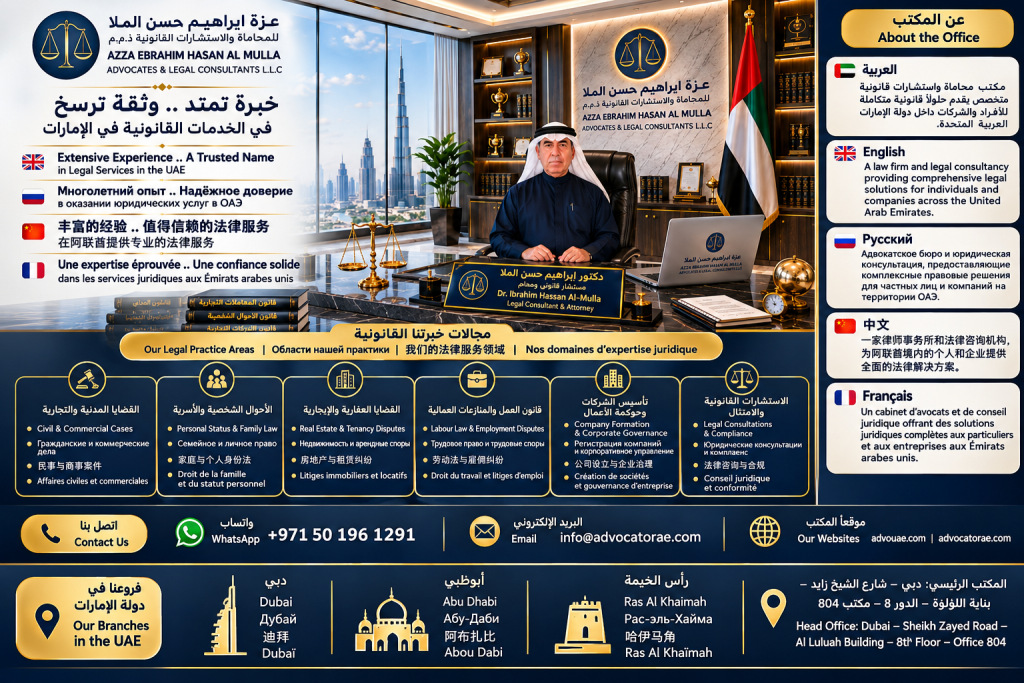
21. Azza Ibrahim Hassan Al-Mulla Advocates & Legal Consultants — Contact Information
intellectual property protection for companies in the UAE, trademark registration in the UAE, trade secret protection for companies, intellectual property rights in the UAE 2026, patent protection in the UAE
Azza Ibrahim Hassan Al-Mulla Advocates & Legal Consultants provides legal services relating to corporate matters, commercial agreements and disputes involving intellectual property rights in the United Arab Emirates.
Legal file review may include trademark certificates, software development contracts, licensing agreements, correspondence and evidence relating to suspected infringement.
Legal Consultant: Dr. Ibrahim Hassan Al-Mulla.
Office locations: Dubai, Abu Dhabi and Ras Al Khaimah, United Arab Emirates.
Telephone: +971 50 196 1291
WhatsApp: +971 50 196 1291
Website: advo-uae.com
Additional website: advocatorae.com
To request an appointment, please provide the relevant registration certificates, agreements, correspondence and a brief description of the issue.
A consultation can be arranged with Legal Consultant Dr. Ibrahim Hassan Al-Mulla to review the documents and assess the appropriate legal options under UAE law.
intellectual property protection for companies in the UAE, trademark registration in the UAE,
trade secret protection for companies, intellectual property rights in the UAE 2026, patent protection in the UAE